Uses
- Waterproof sealing of joints in building envelopes.
- Sealing of movement joints in concrete structures.
- Sealing of joints between precast concrete elements.
- Sealing of concrete connection joints.
- Sealing around door and window perimeters.
- Suitable for construction joints requiring ±25% movement capability.
Advantages
- One-component, moisture-curing polyurethane sealant.
- High-modulus elastic performance.
- Excellent resistance to weathering.
- Movement capability of ±25%.
- Excellent workability and easy finishing.
- Good adhesion to a variety of construction materials.
- Paintable after full curing, subject to compatibility testing.
- Can be sanded after curing.
- Ready to use without on-site mixing.
- Non-sag consistency for vertical and horizontal joints.
Standards Compliance
- Tested in accordance with ASTM C920-18 (2024).
- Joint design recommendations are based on DIN 18540 guidance.
Joint Design
The joint width must be designed according to the expected movement and the movement capability of the sealant.
- Recommended joint width: 10–35 mm.
- Recommended joint depth: 8–15 mm.
- Recommended width-to-depth ratio: 2:1.
- Use a closed-cell polyethylene foam backing rod to control the sealant depth.
| Joint Spacing |
Recommended Width |
Recommended Depth |
| 2 m |
10–15 mm |
8 mm |
| 2–3.5 m |
15–20 mm |
10 mm |
| 3.5–5 m |
20–25 mm |
12 mm |
| 5–6.5 m |
25–30 mm |
15 mm |
| 6.5–8 m |
30–35 mm |
15 mm |
The final joint design must comply with applicable local regulations and account for the building structure, component dimensions, technical requirements, environmental conditions and sealant performance.
Substrate Preparation
All bonding surfaces must be clean, dry, sound and homogeneous. Remove grease, dust, cement laitance, loose particles and any contaminants that may reduce adhesion.
Priming and Pre-Treatment
Non-Porous Substrates
For metals, coatings and similar non-porous substrates, lightly abrade the surface and clean it with PU-205 using a clean cloth. Allow it to dry for approximately 10 minutes, then apply PU-3N primer using a brush. Allow the primer to dry for 30 minutes and apply the sealant within a maximum of 8 hours.
Porous Substrates
For concrete, aerated concrete, cement render, mortar and brick, apply PU-3N primer. Allow it to dry for 30 minutes and apply the sealant within a maximum of 8 hours.
Primers improve adhesion but do not replace proper surface cleaning or strengthen weak substrates. An adhesion test should be carried out on project-specific materials before full application.
Application
- Ensure that the substrate and joint are properly prepared.
- Install a suitable closed-cell polyethylene backing rod at the required depth.
- Apply the appropriate primer when required and observe its recommended drying time.
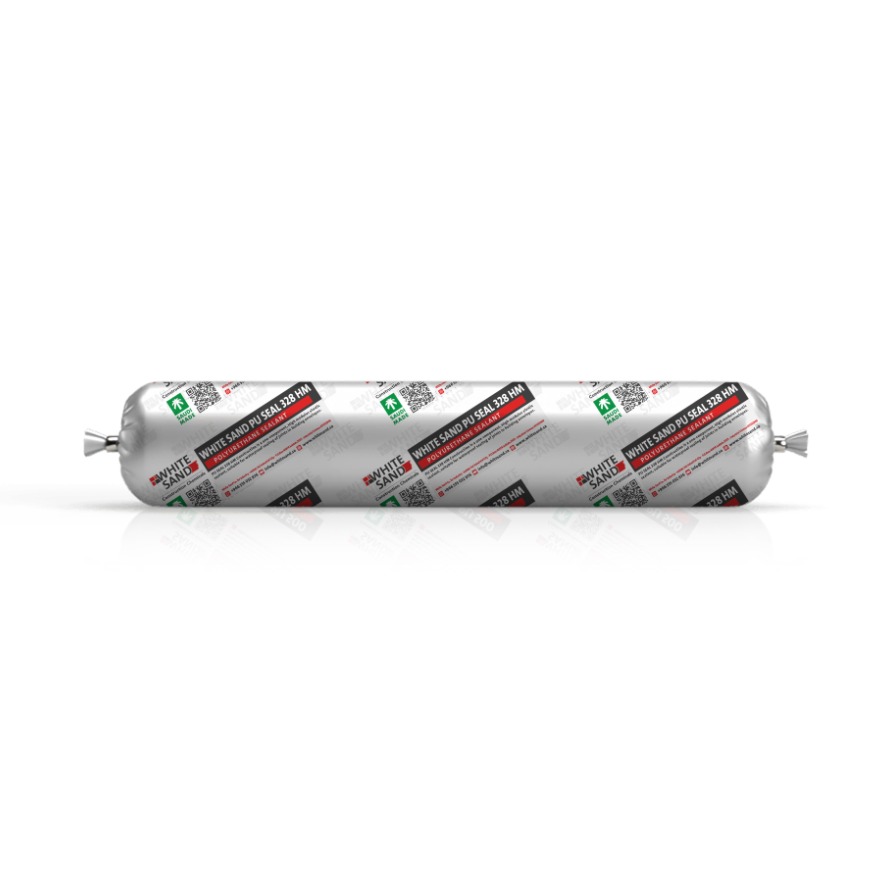
- Place the 600 ml sausage inside a suitable caulking gun.
- Extrude the sealant continuously into the joint.
- Ensure complete contact with both sides of the joint and minimize trapped air.
- Tool the sealant immediately after application to press it firmly against the joint sides.
- Use masking tape when clean joint edges are required.
- Remove the masking tape before the sealant begins to form a skin.
Application Conditions
- Application temperature: 5°C to 40°C.
- Substrate temperature: 5°C to 40°C.
- The substrate temperature must be at least 3°C above the dew point.
Yield and Coverage
The following values indicate the approximate number of linear metres obtained from one 600 ml sausage:
| Joint Width |
Joint Depth |
Approximate Coverage |
| 10 mm |
8 mm |
Approximately 7.5 linear metres |
| 15 mm |
8 mm |
Approximately 4.5 linear metres |
| 20 mm |
10 mm |
Approximately 2.5 linear metres |
| 25 mm |
12 mm |
Approximately 1.6 linear metres |
| 30 mm |
15 mm |
Approximately 1.3 linear metres |
The stated consumption values are approximate. Actual consumption depends on the joint dimensions, application method and material wastage.
Limitations
- Allow the product to cure completely before painting.
- Test paint compatibility before application.
- Rigid or non-elastic paint may reduce the flexibility of the sealant and cause cracking.
- Exposure to chemicals, elevated temperatures or ultraviolet radiation may cause color changes, particularly in white sealant, without affecting performance.
- Do not apply to asphalt, natural rubber, EPDM or materials that release oil, plasticizers or solvents.
- Not recommended for joints subjected to prolonged water immersion, such as swimming pools.
- Do not apply uncured sealant to alcohol-containing surfaces.
- Do not mix the uncured sealant with alcohol-based solvents, cleaning agents or release agents because they may interfere with curing.
Cleaning
Remove uncured PU SEAL 328 HM using Remover-208, Top-Clean T or another suitable cleaning agent. Fully cured material can only be removed mechanically.
Storage and Shelf Life
Store PU SEAL 328 HM in its original unopened packaging in a dry environment at a temperature between 5°C and 25°C, protected from direct sunlight.
The product has a shelf life of 9 months when stored under the recommended conditions.
Packaging
- 600 ml sausages.
- 20 sausages per box.
Health and Safety
- Use suitable protective gloves and safety goggles during application.
- Avoid unnecessary contact with the skin and eyes.
- Ensure adequate ventilation, particularly in enclosed areas.
- Refer to the latest Safety Data Sheet for handling, storage, disposal, physical, ecological and toxicological information.
- Dispose of the product and packaging according to applicable local regulations.
Quality and Technical Support
WHITE SAND products are developed and manufactured under a quality-oriented product-development process and an independently certified quality management system.
WHITE SAND provides technical assistance and guidance regarding joint design, substrate preparation, primer selection, sealant application and other construction-chemical requirements.