
As the FIFA World Cup 2026 captures the attention of billions around the world, football fans are reminded of a timeless truth:
Championships are not won by attack alone. They are built on strong defense.
The teams that lift trophies are often the teams that prevent problems before they happen. They protect their goal, minimize risks, and stay resilient under pressure.
Interestingly, the same principle applies to construction.
Defense Wins More Than Football Matches
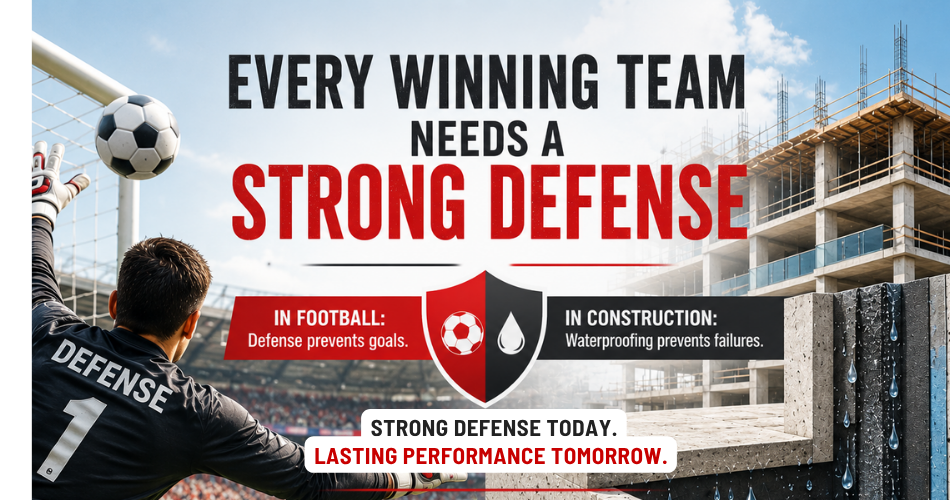
In football, a strong defense prevents goals.
In construction, a strong protection system prevents failures.
Many building problems do not begin with visible damage. They start silently behind walls, beneath tiles, inside concrete, or below ground level.
Water infiltration, moisture penetration, chloride attack, and substrate deterioration often develop long before the first visible sign appears.
By the time leaks, cracks, mold, or surface failures become obvious, the cost of repair can be significant.
This is why preventive protection is one of the most important investments in any construction project.
The Hidden Opponent: Water
Water is one of the most persistent challenges facing buildings and infrastructure.
It can affect:
- Roof slabs
- Water tanks
- Swimming pools
- Foundations
- Bathrooms
- Balconies
- Basements
- Concrete structures
Even structures that appear strong on the surface can suffer long-term deterioration if water finds a pathway into the substrate.
Over time, moisture can lead to:
- Reinforcement corrosion
- Concrete deterioration
- Coating failures
- Tile debonding
- Mold growth
- Increased maintenance costs
The challenge is not simply stopping water today.
The challenge is preventing water-related failures for years to come.
Prevention Costs Less Than Repair
Football coaches know that preventing a goal is easier than recovering from one.
Construction professionals understand the same lesson.
Repairing damaged concrete, removing failed finishes, replacing tiles, and addressing structural deterioration can be far more expensive than implementing proper protection during construction.
A proactive waterproofing strategy helps:
- Extend service life
- Reduce maintenance costs
- Protect structural integrity
- Improve building durability
- Enhance long-term project value
Building a Defensive System
Just as football teams rely on an organized defensive system rather than a single player, buildings require a complete protection system.
Successful waterproofing depends on:
Proper Surface Preparation
A waterproofing system is only as strong as the substrate beneath it.
Quality Waterproofing Materials
The selected system must withstand water pressure, movement, and environmental exposure.
Crack Bridging Performance
Concrete naturally moves due to temperature changes and loading conditions.
Flexible waterproofing systems help accommodate these movements.
Long-Term Durability
The goal is not simply passing an initial inspection.
The goal is maintaining protection throughout the building’s life cycle.
The Role of Modern Waterproofing Solutions
Today’s construction projects require waterproofing technologies that provide more than a simple barrier.
Advanced waterproofing systems are designed to:
- Resist water penetration
- Bridge substrate cracks
- Protect concrete against carbonation
- Reduce chloride ingress
- Allow water vapor transmission
- Maintain adhesion under wet conditions
These characteristics help structures remain protected even when exposed to demanding environmental conditions.
Final Thought
The most successful football teams understand that defense is not about playing cautiously.
It is about creating a strong foundation that allows everything else to perform at its best.
Construction follows the same principle.
Whether protecting a roof, foundation, swimming pool, water tank, or concrete structure, long-term performance depends on preventing problems before they occur.
Because in football, defense prevents goals.
And in construction, waterproofing prevents failures.
Strong defense today creates lasting performance tomorrow.