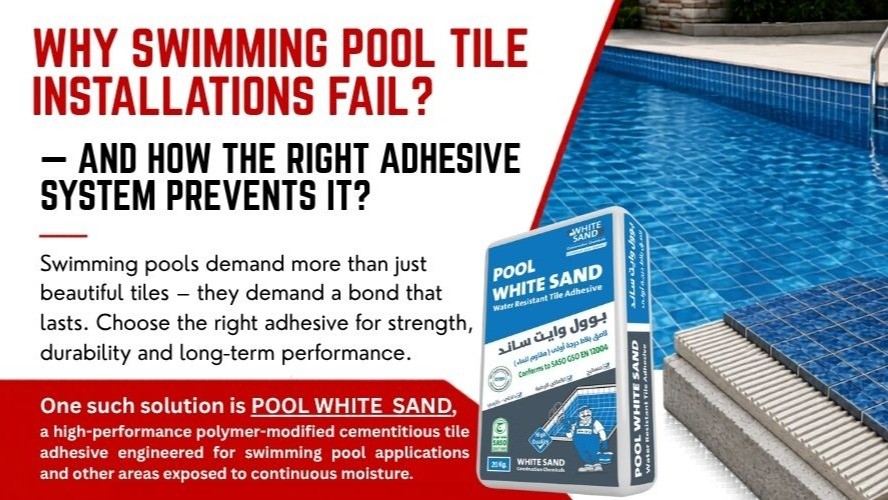
Swimming pools are designed to provide years of enjoyment, but beneath the waterline lies one of the most demanding environments for tile installations. Constant exposure to water, chemicals, temperature variations, and structural movement can place significant stress on tiles and the materials used to fix them.
When pool tiles begin to loosen, crack, or detach, many assume the problem lies with the tile itself. In reality, the failure often starts with the adhesive layer hidden beneath the surface.
The Challenges of Pool Tile Installation
Unlike conventional wall or floor tiling applications, swimming pools operate under continuous moisture exposure. Every component of the tiling system must withstand:
- Permanent water immersion
- Chlorine and chemical treatments
- Thermal expansion and contraction
- Hydrostatic pressure
- Interior and exterior weather conditions
These factors make adhesive selection a critical part of the pool construction process.
Common Causes of Tile Failure
Many tile failures can be traced back to the use of adhesives that were not designed for submerged applications. Over time, inadequate bonding can result in:
- Hollow or loose tiles
- Water penetration behind the tiles
- Cracked grout joints
- Tile slippage during installation
- Costly maintenance and repairs
Even when high-quality tiles are used, the entire installation can be compromised if the adhesive cannot maintain its performance under demanding conditions.
The Solution: High-Performance Polymer-Modified Adhesives
To ensure long-term durability, industry professionals increasingly specify polymer-modified cementitious tile adhesives developed specifically for wet and submerged environments.
One such solution is POOL WHITE SAND, a high-performance polymer-modified cementitious tile adhesive engineered for swimming pool applications and other areas exposed to continuous moisture.
Its advanced formulation offers several key benefits:
Excellent Bond Strength
Provides reliable adhesion between the tile and substrate, helping to prevent debonding and tile movement over time.
Superior Water Resistance
Designed to perform in wet and submerged conditions, reducing the risk of water-related deterioration.
Easy Application and Improved Productivity
Its smooth workability allows installers to achieve efficient coverage and consistent installation quality.
Slump-Free and Non-Sag Performance
Supports secure installation on both floors and walls, keeping tiles in place during application.
Suitable for Interior and Exterior Use
Ideal for swimming pools, water features, wet areas, and other demanding tiling environments.
Building Pools for Long-Term Performance
Successful pool construction requires more than attractive tiles and quality workmanship. It depends on selecting a complete installation system capable of performing under continuous exposure to water and environmental stresses.
By incorporating high-performance solutions such as POOL WHITE SAND into the tiling system, contractors and project owners can improve durability, reduce maintenance concerns, and help ensure that swimming pool finishes remain secure and visually appealing for years to come.
In swimming pool construction, what lies beneath the tile is often just as important as the tile itself.
📲 WhatsApp: wa.me/+966552474087
Technical Data Sheet available for download at https://www.whitesand.sa/products/tiling-systems/pool-white-sand/